When should a child begin to train, and why the old fear was wrong
Most parents think lifting weights is dangerous for children. Twenty years of paediatric consensus disagree, and the reason has more to do with the nervous system than with muscle.
Most parents think lifting weights is dangerous for children. Twenty years of paediatric consensus disagree, and the reason has more to do with the nervous system than with muscle.

Parents are told that writing by hand is vital for their child's growing brain, and that screens are eroding it. We sort the viral headlines from the solid evidence, and find the real benefit belongs to one group above all: children still learning their letters.
Your child's fussiness for food is mostly inherited, and most of the things parents try in order to fix it make it worse. Find out why young children refuse food, why it is rarely a parent's fault, and the unglamorous method that genuinely changes how they eat.
Chronic pain in children is more common than being left-handed. And adults are surprisingly bad at reading how much pain a child is in. This is what all parents should know.


Your child falls. Instantly, you try to calculate how hard was the fall. How real is their cry. Does their grazed knee need a plaster, a hug and a biscuit? Or are they more seriously hurt? It's always hard to know exactly what a child is feeling, and how much pain they are in.
And for good reason. Children's pain is one of the least researched areas of child health, and the studies that do exist point somewhere uncomfortable.
Adults are not good at judging how much pain a child is in, studies show. Parents misread it, doctors misread it more, and how badly they misread it depends on the child's age, sex and skin colour.
What's more, the latest science reveals that far more children live with silent, chronic pain than we tend to imagine. It's around one in five, and for many it quietly shapes their schooling, their friendships and the rest of their lives.
A child's pain is harder to read than it looks. A child also expresses pain differently as they grow.
In the first months of life, a baby's pain is written almost entirely on their face and in their cry, and we tend to trust those signals. We should be more careful.
One striking study measured brain activity alongside behaviour during a heel prick and found that on the occasions when infants showed no change in facial expression at all, most still produced a clear pain response in the brain.
A baby can be in pain and not look it. The face is the signal we read most readily, and it is an incomplete one.
In the second year, children begin to control their own distress. Researchers filmed toddlers being vaccinated at twelve, eighteen and twenty-four months and watched how quickly each child recovered from the needle. The twelve-month-olds were still crying and distressed minutes after the jab. The eighteen- and twenty-four-month-olds had mostly settled within two or three minutes.
The older a toddler gets, the better they become at damping down the pain they show, often by copying how the adults around them react. The same pain produces a quieter child.
Once a child can talk, asking them becomes the best way to gauge their pain, and researchers treat a child's own report as the gold standard. But this is also the age when children learn that pain can be hidden, exaggerated or played down depending on who is watching.
So there is no single, reliable way to see a child's pain. What works for a baby misleads for a toddler, and the toddler who shows everything grows into the schoolchild who has learned to keep a straight face.
When a child's pain is hard to read, adults fill the gap with assumptions, and those assumptions are not random. They follow the child's sex and skin colour, and they are often wrong.
Parents are often blamed for missing their children's suffering, but the research points the other way. When patients, parents and clinicians rate the same child's pain, parents track it more closely than the professionals do.
In one emergency-department study, both parents and doctors rated children's pain lower than the children themselves did, but the parents' estimates sat much nearer the child's own, while the doctors' fell furthest below, and barely half of the children in severe pain received any pain relief.
The practical lesson the researchers drew was blunt: without a clear self-report from the child, the parent's judgement deserves weight, because the professional's instinct skews low.
Persistent pain in childhood is about as common as left-handedness, and far more consequential
A child's sex changes how adults read their pain, and not in the direction most people expect. In a much-replicated experiment, adults watched a video of a child having a finger-prick blood test. Half were told the child was a boy, half a girl. The footage was identical, yet adults rated the "boy" as in more pain than the "girl".
A larger, pre-registered replication confirmed the effect and pinned down its cause: when researchers accounted for adults' explicit gender stereotypes, the belief that girls are more sensitive or more given to dramatising while boys are stoic, the bias disappeared. The stereotype does the work. Because adults expect girls to make more of pain, they discount it when a girl shows it, and credit it when a boy shows the very same thing.
This echoes a deep vein of research in adults, where women's pain is consistently underestimated relative to men's and more often attributed to emotion rather than to a physical cause. The childhood version of the bias is the early root of a problem that follows girls into adult medicine.
A child's skin colour shifts the judgement too, and more harmfully. Across a series of experiments, adults, including schoolteachers, judged young Black children to be feeling less pain than white children in identical circumstances. The researchers traced this in part to a false belief that Black children have had harder lives and are therefore more hardened to pain.
These judgements were not idle. The same study found they shaped the pain treatment the adults said they would give. How much pain a child is believed to be in, and how much relief they are offered, depends partly on who the adult thinks that child is.
So far this is about the pain a child shows in the moment. The bigger problem is the pain a child never reports at all.
In 2024 a major review in the journal Pain pooled 119 studies covering more than a million children across seventy countries. It found that around one in five children and adolescents lives with chronic pain, meaning pain that lasts or keeps returning for more than three months. Headaches and musculoskeletal pain were the most common, each affecting roughly a quarter of the children in studies that looked for them.
This was no fringe finding from one unusual sample. It was a careful update of an earlier review, and it landed on a number that should give any parent pause. Persistent pain in childhood is about as common as left-handedness, and far more consequential.
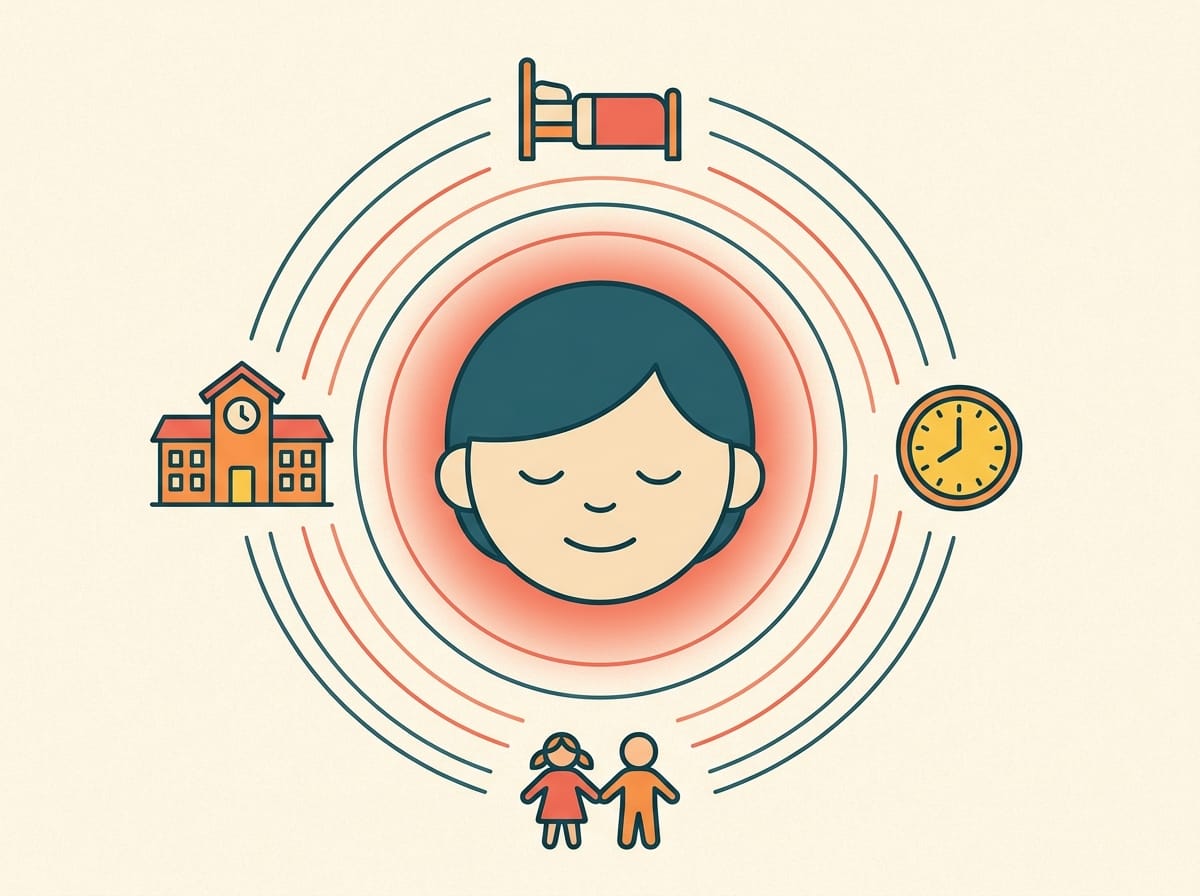
Chronic pain does not stay in the body part that hurts. In a community study of more than a thousand children, those whose pain was bad enough to interfere with daily life slept worse, tired more easily, carried more anxiety and depression, concentrated less well and missed more school than children with milder pain or none.
The school effect in particular shows up again and again. Drawing on a national survey of nearly fifty thousand American children, one study found that children with chronic pain were more than four times as likely to be chronically absent from school, and were also more likely to struggle with schoolwork and to repeat a grade.
The associations were strongest among adolescents and, notably, among boys. That last detail sits in interesting tension with the prevalence picture, where girls report more chronic pain than boys for most pain types: girls carry more of the pain, but when boys have it, it disrupts their schooling more sharply.
The longer view is sobering. Following a nationally representative group of American young people over twelve years, researchers found that adolescents who had chronic pain went on, as young adults, to have lower educational attainment, poorer employment outcomes and a cluster of social disadvantages, even after accounting for adolescent depression and family circumstances.
A child who hurts at age fifteen, in other words, may still be carrying the consequences at age twenty-seven.
And the weight does not fall on the child alone. A study of nearly two thousand families attending paediatric pain services across Australia and New Zealand found that caregivers reported substantial work impairment and high psychosocial burden, worse on several measures than caregivers of children with other chronic conditions. When a child is in lasting pain, the whole household absorbs it.
None of this means a parent should become an anxious auditor of every wince. It means something more useful, which is that a child's pain is real information even when it is quiet, inconvenient or easy to explain away, and that the instinct to take it seriously is usually the correct one.
The research that finds parents tracking their children's pain more closely than clinicians do is, read another way, reassuring: a parent's sense that something is wrong is generally a signal worth trusting, especially against a medical system whose reflex is to rate pain low.
Three things follow. The first is that recurring pain deserves attention even without a visible cause. A child who has a headache or a stomach ache every few weeks, or whose legs ache at night often enough that it has become normal, is describing something that one in five of their peers also lives with, and that is worth raising with a GP rather than absorbing as part of the furniture of childhood.
The second is that a calm or stoic child is not necessarily a comfortable one. Because children learn to regulate and to mask pain as they grow, and because some are temperamentally less expressive, the quietest child in pain may be the one most likely to be missed.
The third is to notice the assumptions we bring. Knowing that adults tend to under-credit girls' pain, and to under-credit the pain of children of colour, is the first defence against doing it.
Taking a child's pain seriously does not mean treating every cry as an emergency. It means remembering that pain in childhood is common, that children show it differently as they grow, and that adults judge it through biases they rarely notice.
A child whose pain is believed, and met calmly rather than with panic, learns something worth keeping: that their own account of their body is worth giving, and worth trusting.
2024, Chambers CT et al., The prevalence of chronic pain in children and adolescents: a systematic review update and meta-analysis, Pain
2023, Miró J et al., Chronic pain and high impact chronic pain in children and adolescents: a cross-sectional study, The Journal of Pain
2020, Groenewald CB, Tham SW & Palermo TM, Impaired school functioning in children with chronic pain: a national perspective, The Clinical Journal of Pain
2020, Murray CB, Groenewald CB, de la Vega R & Palermo TM, Long-term impact of adolescent chronic pain on young adult educational, vocational, and social outcomes, Pain
2024, Ngo D et al., Caregiver burden associated with pediatric chronic pain: a retrospective study using the Pediatric Electronic Persistent Pain Outcomes Collaboration database, The Clinical Journal of Pain
2016, Thrane SE, Wanless S, Cohen SM & Danford CA, The assessment and non-pharmacologic treatment of procedural pain from infancy to school age through a developmental lens: a synthesis of evidence with recommendations, Journal of Pediatric Nursing
2017, Brudvik C, Moutte S-D, Baste V & Morken T, A comparison of pain assessment by physicians, parents and children in an outpatient setting, Emergency Medicine Journal
2025, Jasim S et al., Cardiac and behavioural trends in toddler pain distress responses across early development, Scientific Reports
2008, Slater R, Cantarella A, Franck L, Meek J & Fitzgerald M, How well do clinical pain assessment tools reflect pain in infants?, PLoS Medicine
2014, Cohen LL, Cobb J & Martin SR, Gender biases in adult ratings of pediatric pain, Children's Health Care
2019, Earp BD, Monrad JT, LaFrance M, Bargh JA, Cohen LL & Richeson JA, Gender bias in pediatric pain assessment, Journal of Pediatric Psychology
2021, Zhang L, Reynolds Losin EA, Ashar YK, Koban L & Wager TD, Gender biases in estimation of others' pain, The Journal of Pain
2024, Summers KM, Pitts S & Lloyd EP, Racial bias in perceptions of children's pain, Journal of Experimental Psychology: Applied

Most parents think lifting weights is dangerous for children. Twenty years of paediatric consensus disagree, and the reason has more to do with the nervous system than with muscle.

Parents are told that writing by hand is vital for their child's growing brain, and that screens are eroding it. We sort the viral headlines from the solid evidence, and find the real benefit belongs to one group above all: children still learning their letters.

Your child's fussiness for food is mostly inherited, and most of the things parents try in order to fix it make it worse. Find out why young children refuse food, why it is rarely a parent's fault, and the unglamorous method that genuinely changes how they eat.

Most of what shapes a young life turns out to be joyful and ordinary. A major new study shows what teenagers themselves treasure, and why the way they answer can tell you how they are really doing.