New research reveals that bullying can actually cause post-traumatic stress in children. If your child can’t 'bounce back' from being bullied, they aren't weak. We explain the biology of the hurt, and how to help them heal.
Why is your daughter so stressed? New research shows high-achieving girls often link their self-worth to their grades. Constant notifications from school apps mean they can never truly switch off. Learn how to help her value herself beyond the screen and give her permission to be human.
It can feel like wasting money on 'fake' items. But for your child, digital assets and skins are a ticket to social belonging. We explain the science behind the screen and how to handle the requests.
For Your Daughter, Success Can Feel Like A Burden: Understanding The New Science of Academic Stress
Why is your daughter so stressed? New research shows high-achieving girls often link their self-worth to their grades. Constant notifications from school apps mean they can never truly switch off. Learn how to help her value herself beyond the screen and give her permission to be human.
It is a common sight in modern households: a daughter staying up late, surrounded by textbooks, seemingly driven by a high level of expectation that feels more intense than what many of us experienced in our own school days. As parents, we often watch this with a mixture of pride and profound unease.
We want our children to work hard, yet there is a specific kind of internal to this modern diligence - a sense that she feels the stakes are not just about her grade, but about her very identity. New research is helping us understand why this might be happening and why the pressure seems to fall so heavily on young women.
Join The Inquisitive Parent to read the full analysis, including the "Achievement Paradox" (why high grades can actually fuel anxiety), the specific data on the "Fear of Shame" in adolescents, and the research evidence for how 24/7 digital school surveillance is affecting student rest.
The researchers found that older girls’ internal expectations - often called perfectionism - lead to higher levels of academic stress and can take a measurable toll on their mental well-being.
While this specific research was conducted in China, the findings mirror a growing global pattern; the psychological link between female gender roles and internalized pressure appears to transcend cultural borders. It suggests that the drive to be "perfect" is a shared experience for many young women today.
For many girls, this pressure is not coming from teachers or parents, but from an internal requirement they have set for themselves to be beyond reproach.
To understand why girls are more prone to this, we have to look at how they process the idea of falling short. In previous generations, a "bad" grade might have been seen as a temporary disappointment or a sign to study harder next time. However, for the modern student, the internal dialogue has changed.
This is a critical distinction for parents to understand. While a boy might view a poor grade as an isolated event or even a result of bad luck, girls are statistically more likely to see it as a reflection of their personal value. This makes every assignment feel like a high-stakes test of their character rather than just a school task.
When a child believes that their worth is conditional on their performance, the stress they feel is not just about the work itself - it is a defensive reaction to the threat of losing their status as a "good student" or a "successful person."
Surprisingly, achieving the very success they strive for does not always provide the relief we might expect. We often assume that once a student gets that "A," their anxiety will dissipate.
However, another study published in 2021, The Longitudinal Associations between Perfectionism and Academic Achievement across Adolescence, suggests the opposite can occur. This research found that a child’s high achievement can actually increase their sense of perfectionism over time. When a student achieves top marks, they often feel a new, heavy pressure to maintain that status.
Success, rather than building a sense of security, creates a cycle where the student feels they have more to lose.
The higher they climb, the more they fear the fall, making them more anxious about future performance even as their school report card continues to show top marks.
When we see our daughters working so hard, it can be difficult to know whether we should encourage their ambition or step in to slow them down. Many of us grew up believing that 'trying your best' was a simple, positive virtue. However, modern science shows us that there is a significant difference between a child who is driven by a personal desire for excellence and one who is haunted by the fear of falling short.
In a large-scale analysis of nearly 9,000 students, researchers identified these as two distinct experiences. They found that 'perfectionistic strivings' - the internal aim to meet high personal standards - can actually be a positive force for a child's growth. The problem arises with 'perfectionistic concerns.' This is the intense, quiet worry about making mistakes and the feeling that their value as a person depends on being beyond reproach.
While the drive to do well is helpful, this underlying anxiety acts as a heavy weight that eventually hinders a student's progress. As parents, our goal is not necessarily to dampen our daughters' drive, but to help them untangle their school results from their sense of self-worth.
This internal pressure is compounded by the way modern schools are structured. In previous decades, school was a physical place with a clear boundary. When the final bell rang, you left the building and, for the most part, your academic identity stayed behind. Your grades were private, shared only with your parents when a paper report arrived in the mail weeks later.
Today, that "off switch" has effectively been removed. The 24-hour nature of digital education has fundamentally altered the student experience.
Research in The Psychological Impact Of Over-Reliance On Educational Apps points out that constant performance tracking and instant feedback through school apps mean students never truly step away from their academic identity. When a student can check their class ranking or a new grade on their phone at any hour of the evening, the mind rarely gets the opportunity to rest.
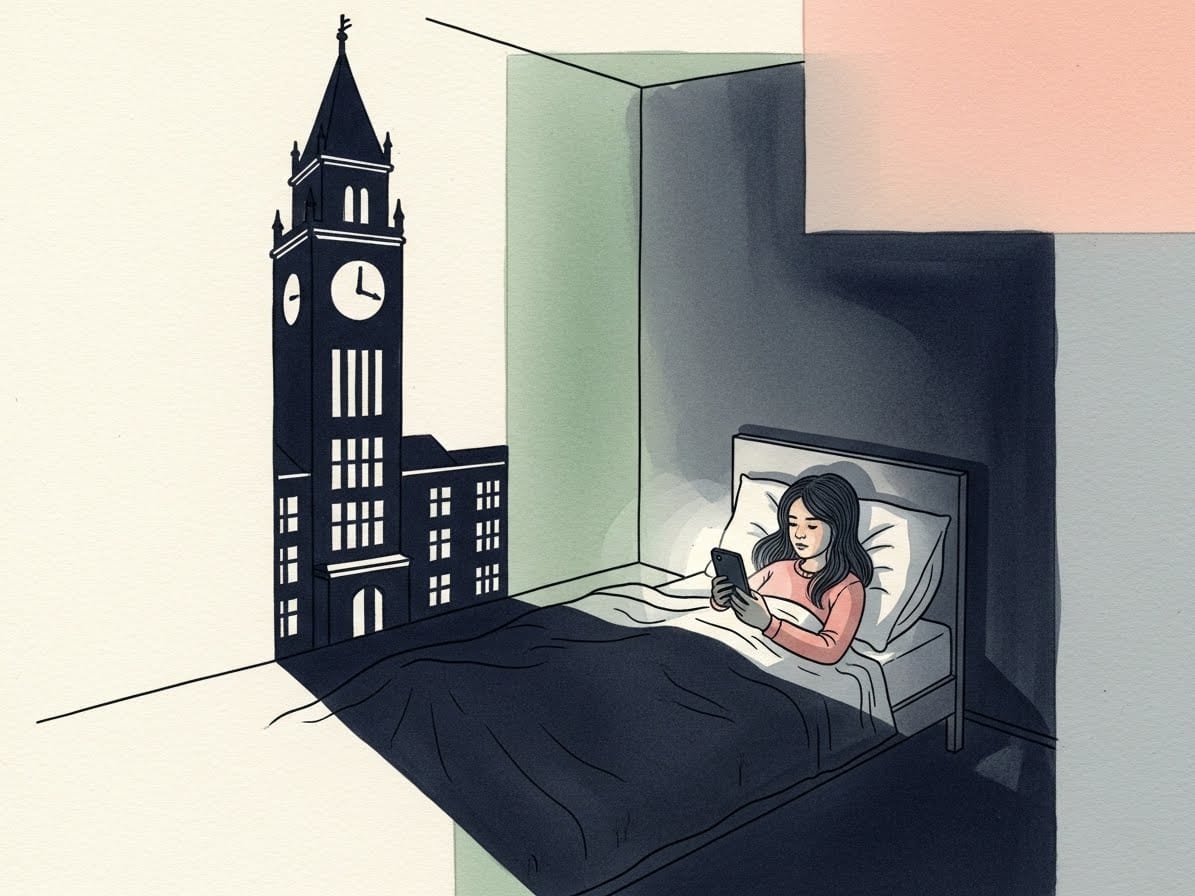
For a girl already prone to perfectionism, these apps act as a constant, digital reminder of the standards she is trying to meet. It creates a state of permanent surveillance, where the pressure to perform is always present, even in the safety of her bedroom.
For a parent who feels nervous or out of their depth, it is helpful to recognize that your daughter is navigating an environment that is fundamentally more demanding and visible than the one we knew. If she seems more stressed than you were at her age, it isn't because she is less resilient; it is because the environment she is living in is more relentless. Her stress is a logical response to a world of constant digital feedback and internal pressure.
By focusing on the effort she puts in and the emotional weight she carries, rather than the final grade, you can help her understand that her value is not something that can be calculated by an app or a single exam.
You can remind her that while school is a part of her life, it is not the sum of who she is. In a world that demands perfection, perhaps the most powerful thing a parent can offer is the permission to be human.
Editor of The Inquisitive Parent and multi-award winning former New Scientist and BBC editor with 20 years' experience, I provide evidence-based reassurance and discover findings to support how your children grow.
New research reveals that bullying can actually cause post-traumatic stress in children. If your child can’t 'bounce back' from being bullied, they aren't weak. We explain the biology of the hurt, and how to help them heal.
It can feel like wasting money on 'fake' items. But for your child, digital assets and skins are a ticket to social belonging. We explain the science behind the screen and how to handle the requests.
Modern parenting pressure to stay 'perfectly calm' can lead to a measurable state of burnout. We examine the latest research explaining why hiding your feelings backfires, and how 'sturdy leadership' offers a clearer path to well-being.
75% of parents want school phone bans, yet teens still scroll for over an hour during class. Why? The answer is uncomfortable: they are mirroring us. We explore the new data on why reclaiming their focus starts with us putting our own phones down.