When should a child begin to train, and why the old fear was wrong
Most parents think lifting weights is dangerous for children. Twenty years of paediatric consensus disagree, and the reason has more to do with the nervous system than with muscle.
Most parents think lifting weights is dangerous for children. Twenty years of paediatric consensus disagree, and the reason has more to do with the nervous system than with muscle.

Parents are told that writing by hand is vital for their child's growing brain, and that screens are eroding it. We sort the viral headlines from the solid evidence, and find the real benefit belongs to one group above all: children still learning their letters.
Your child's fussiness for food is mostly inherited, and most of the things parents try in order to fix it make it worse. Find out why young children refuse food, why it is rarely a parent's fault, and the unglamorous method that genuinely changes how they eat.
Is your child writing letters backward? It’s a common worry, but science shows it’s actually a sign of a healthy, adapting brain - not dyslexia. We break down the 'Mirror Rule' and why your child’s visual system is working exactly as it should. 🎧 13-min listen included.

When you watch your child learn to write, seeing them produce "mirror writing" can trigger immediate alarm. You might see your five-year-old write a perfect letter "b" that is actually reversed, looking exactly like a "d". Sometimes, they might write their entire name backward, starting from the right side of the page and moving to the left.
It is completely natural to pause and wonder if this means your child might be dyslexic. For decades, parents were taught that these reversed letters were a definitive warning sign of a child struggling to read and write as freely as others.
However, the scientific consensus is clear: mirror writing in typically developing children between ages three and eight is not something to be anxious about. It is a functional and expected part of learning to read.
Understanding this process helps distinguish a child who is simply applying a natural visual rule to the alphabet from one who has an actual reading disorder - such as a persistent struggle to match sounds to letters, or mixing up the order of letters within a word. Knowing what to actually look for allows you to better support your child without unnecessary panic.
The Reading Brain
Mirror writing occurs in children due to a conflict between our human biology and modern culture. Our brains are naturally wired to recognize objects regardless of which way they face, but writing using a modern alphabet requires our brains to pay strict attention to the direction each letter faces.
To understand letter reversal, we need to look at how the brain's visual cortex operates. The primary cause of mirror writing is not poor hand coordination, but rather how the brain adapts to new tasks through a process called ‘Neuronal Recycling’.
Because writing systems were invented only about 5,400 years ago, humans are not born with a dedicated reading area in the brain. Yet, brain scans of literate adults consistently show a specific region in the left hemisphere that activates solely for written words.
The brain achieves this by repurposing existing neural circuits that originally evolved to recognize faces and natural objects. This area, known as the Visual Word Form Area, is shifted away from its original function.

In a pre-literate child, this region is tuned to identify objects and tools. As a child learns to read, these neurons are retrained to respond to letters, forcing the brain to overwrite its evolutionary processing rules to accommodate the strict rules of the alphabet.
Mirror Generalization
The most persistent evolutionary rule is ‘Mirror Generalization’. In the physical world, an object remains the same regardless of which way it faces. A physical object, like a hammer, is identical no matter which way the hammer head points.
Evolution wired our vision to ignore left-right differences so we can rapidly identify tools and threats. While excellent for survival, this mechanism makes literacy difficult.
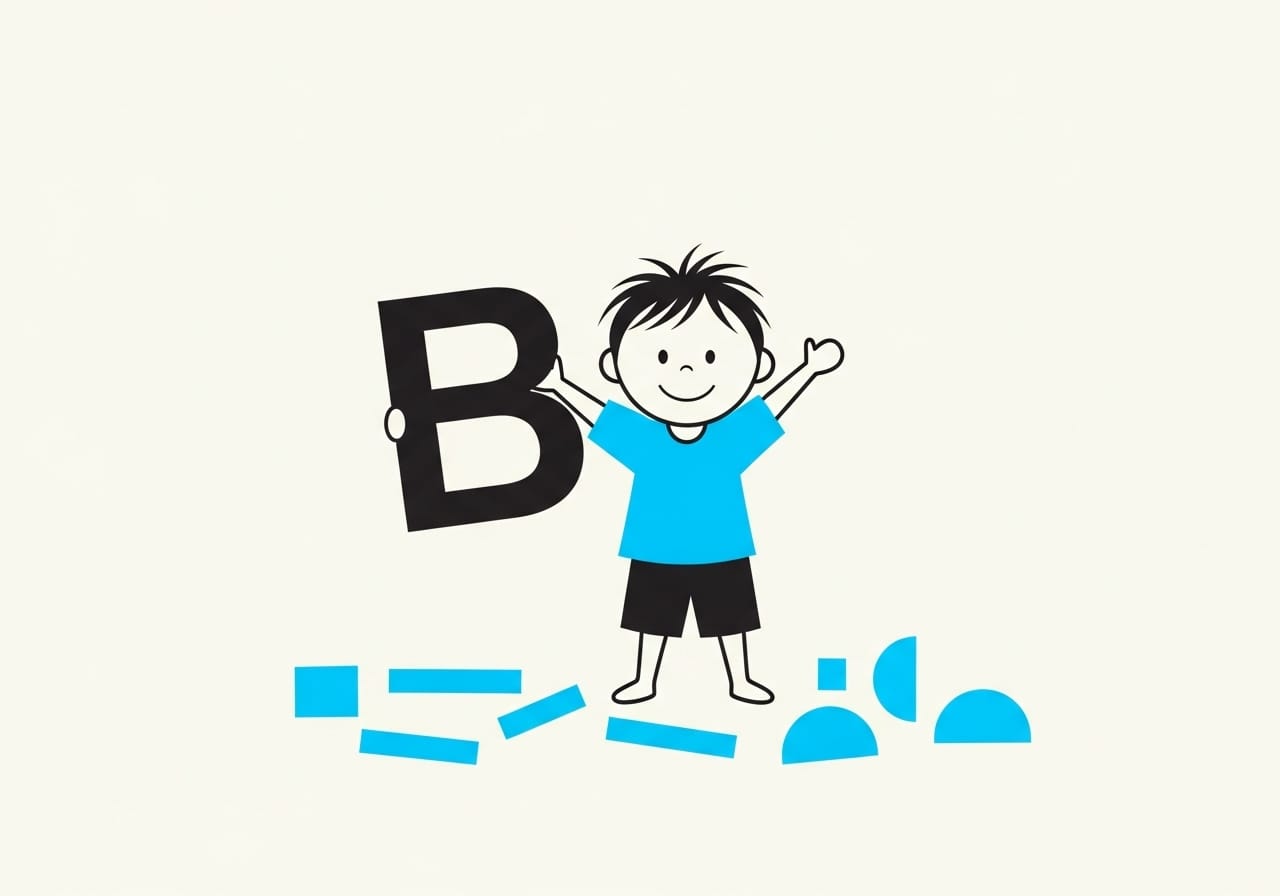
The Latin alphabet relies heavily on orientation. A circle with a vertical line on the left (d) is completely different from one with the line on the right (b).
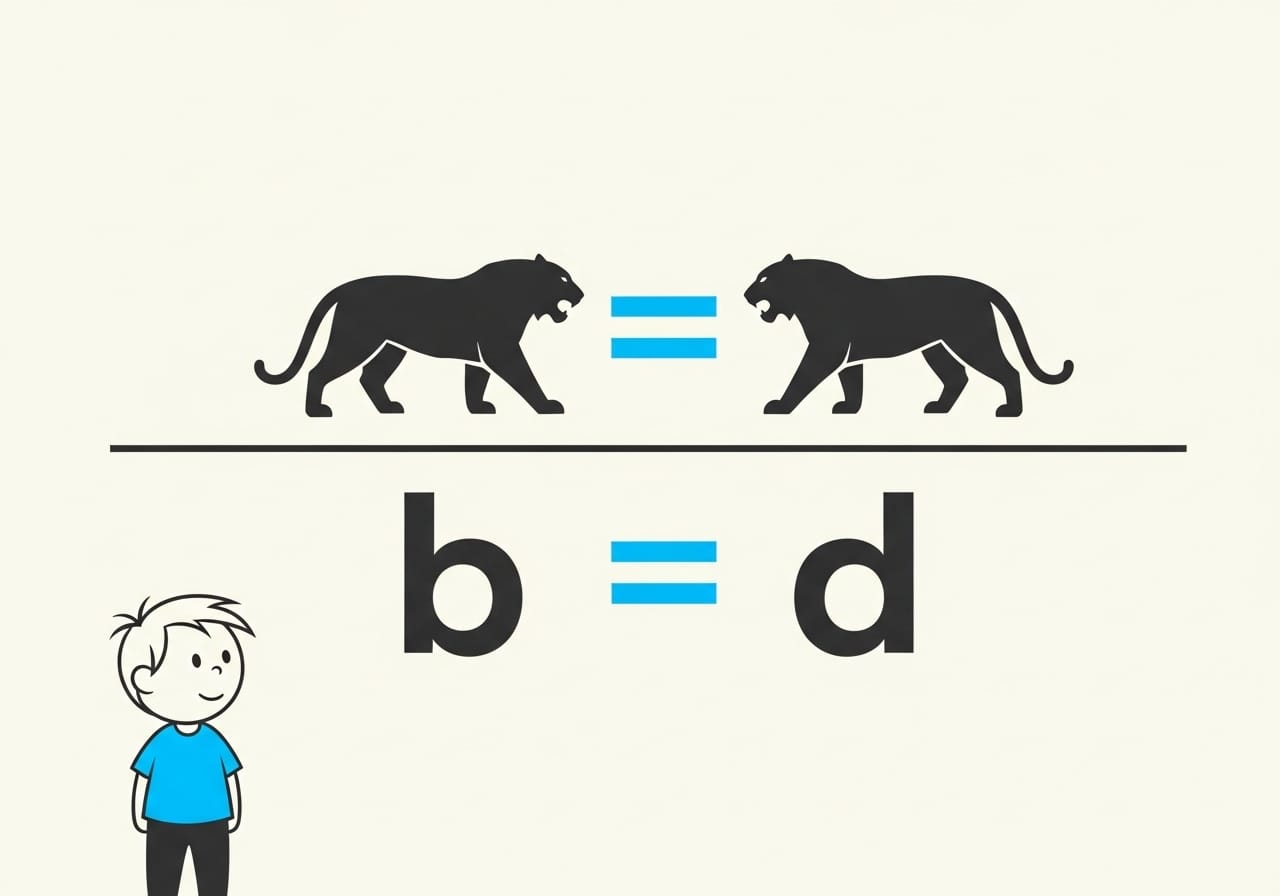
When a typically developing five-year-old looks at a "b" and a "d," their visual system initially reports them as the identical object. The child is not seeing them incorrectly; their brain is simply applying a biologically correct rule to a situation where it no longer applies.
Mirror writing is the physical result of this internal visual conflict. Your child’s brain is functioning correctly according to human biology, but it is still adjusting to the rules of reading.
Breaking Symmetry Takes Effort
Learning to read does not erase mirror generalization; instead, the brain must actively block it. Distinguishing "b" from "d" is an active, energy-consuming process.
To prove this takes active effort, researchers use a specific sequence of visual tests.
First, they ask a child to look at mirror letters and correctly distinguish between them. Immediately after, they show the child two identical pictures of an animal and ask if they are the same. The child's reaction time to the animals slows down noticeably.
This happens because just seconds earlier, the child had to forcefully engage a cognitive block to stop their brain's natural instinct to treat reversed images as identical. That blocking mechanism momentarily remains active. When the animal pictures appear, the brain is still suppressing its default visual rules, creating a brief lag before the child can confirm the two animals are the same.
The errors we see in handwriting occur when this blocking mechanism fails to engage or is overpowered by older biological habits.
The "Right-Writing" Rule
Children also invent hidden rules to navigate letter orientation, leading to specific, predictable errors. Between ages three and five, children may write their entire name backward because the concept of fixed direction does not yet exist for them.
Specific character reversals peak between ages five and seven, intensifying as they learn individual letters. As children move through ages seven and eight, you will typically see these reversals naturally taper off as the brain's visual word form area becomes more specialized. However, learning is not entirely linear, and an occasional backward character when a child is tired or rushing is still perfectly normal.
Researchers have identified a pattern called the "Right-Writing Rule". In the Latin alphabet, most asymmetrical capital letters - such as B, D, E, F, K, L, N, P, and R - open or face to the right. Children naturalize this pattern, defaulting to pointing a character to the right when unsure. This is not just an English language quirk; it is a universal biological response.
A 2025 study of children learning the Greek alphabet found the exact same pattern: characters that face left are significantly more likely to be reversed, proving that the brain applies these spatial rules regardless of the culture or the specific alphabet being learned.
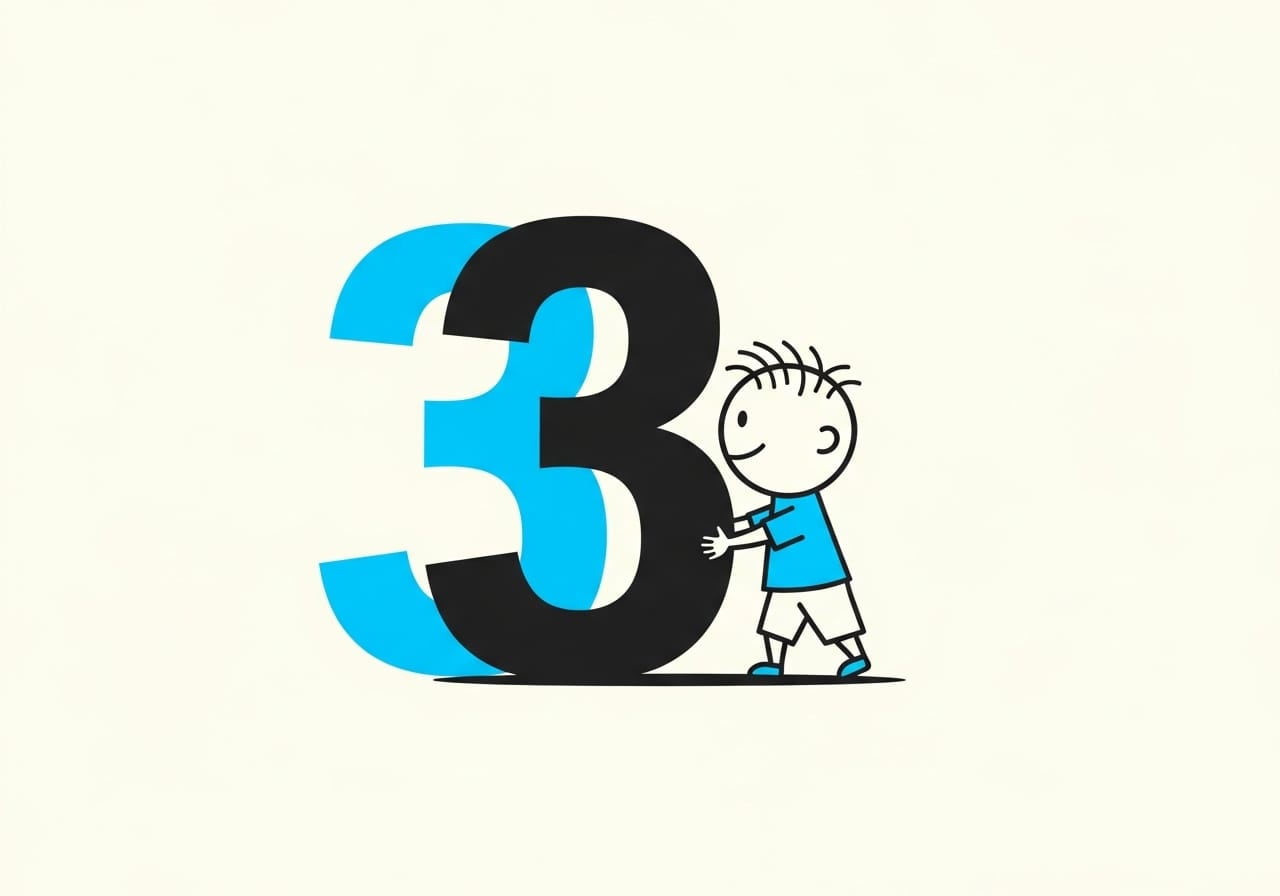
However, this causes errors with numbers, as most asymmetrical Western digits - 1, 2, 3, 7, and 9 - face to the left. If a child applies the "Right-Writing Rule" to the number 3, they flip it to open to the right.
Studies confirm children reverse the digit 3 significantly more often than right-facing digits like 6, simply because they are applying a correct letter rule to numbers.
Dyslexia vs. Typical Development
Despite common fears, letter reversals alone are a poor predictor of dyslexia. It is important to differentiate between the visual and motor errors of a typically developing child and the language processing difficulties of a dyslexic child.
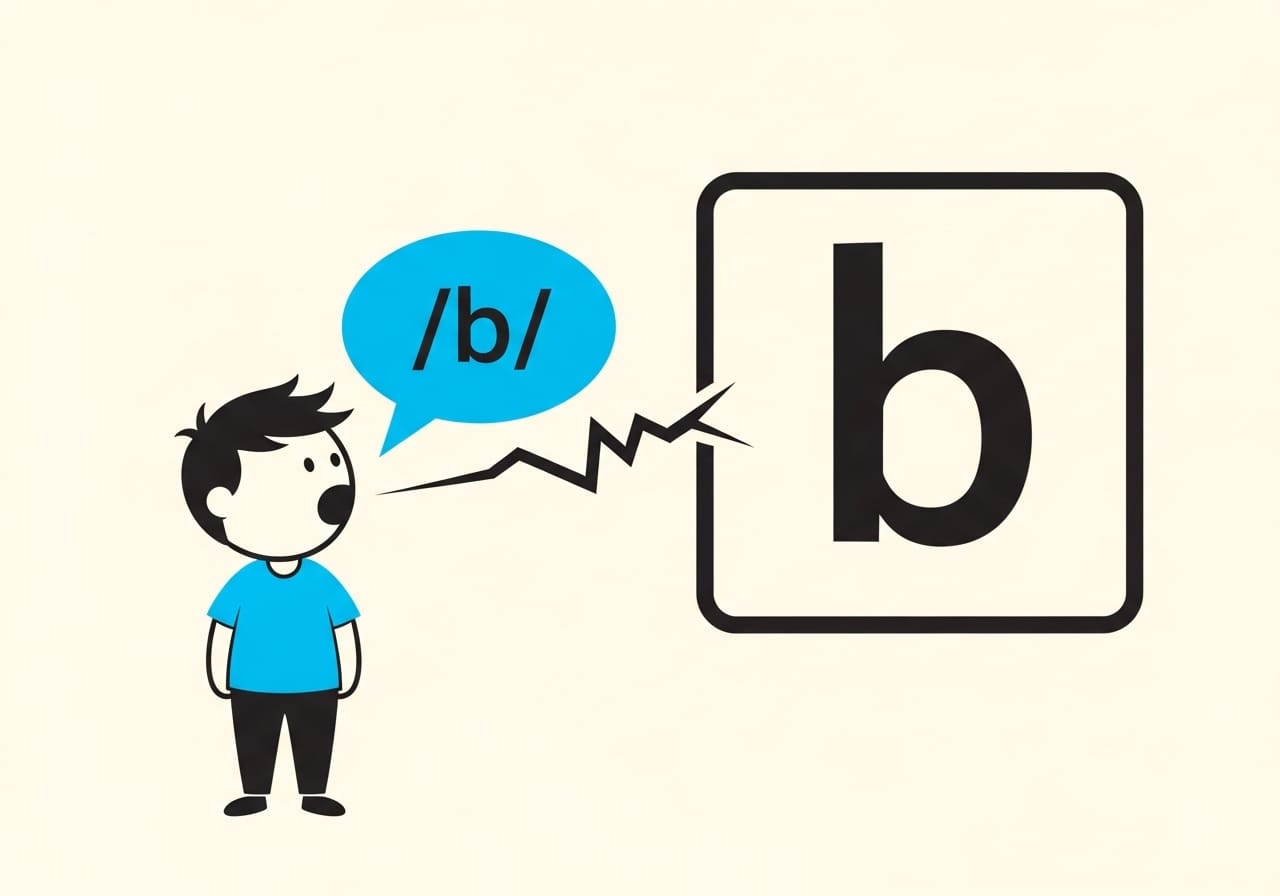
A typical child knows the sound /b/ but struggles to block the mirror image "d" or lacks the motor plan to orient it correctly. In contrast, the primary struggle in dyslexia is connecting sounds to symbols. The child has difficulty mapping the sound /b/ to any letter, regardless of its orientation.
Research highlights "Migration Errors" as a far more specific indicator of reading disorders. While a simple reversal, like writing "dog" as "bog", is common in typical development, a migration error involves mixing up the order of letters within a word, such as reading "cloud" as "could".

These errors indicate a difficulty in processing letter sequences, which is central to dyslexia, and they persist long after simple reversals usually resolve. New technology supports this; the Akshar Mitra AI system, designed for early dyslexia detection, focuses on digital biomarkers derived from eye-tracking, speech, and handwriting analysis to build holistic risk profiles, moving beyond simple reversal monitoring.
Handedness
Parents also often wonder if left-handed children mirror write more frequently.
The most natural arm movement is moving the hand away from the center of the body. For a right-hander, this moves the hand from left to right, aligning with Western writing.
For a left-hander, this moves the hand from right to left, creating a physical tendency to write in that direction. When drawing a horizontal line, a left-handed child instinctively pulls to the left, which can result in mirror script if applied to text.
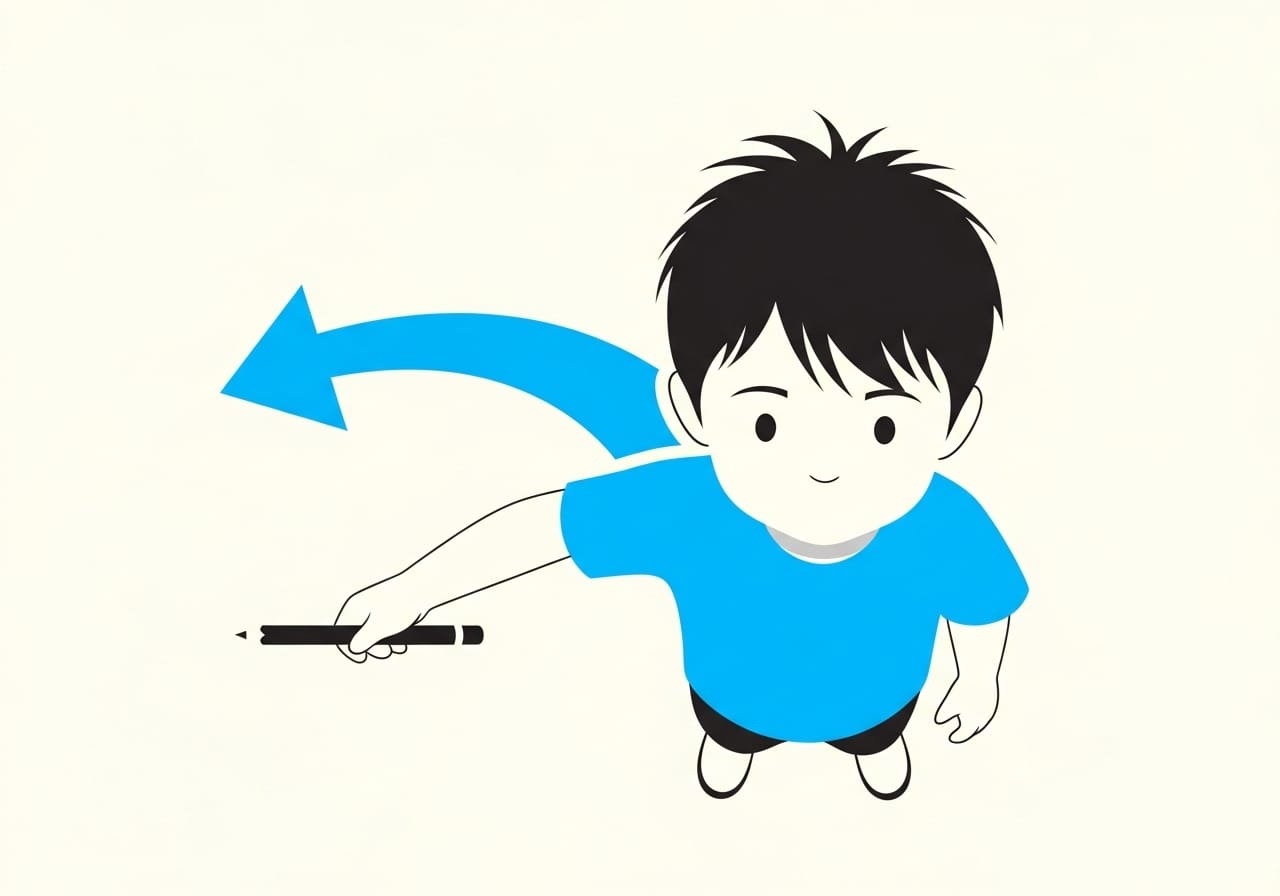
However, while left-handers may exhibit more spontaneous mirror writing between ages three and four, the visual rules of the alphabet quickly override this physical preference. By age six, the error rates between left-handed and right-handed children show no significant difference.
Evidence-Based Interventions
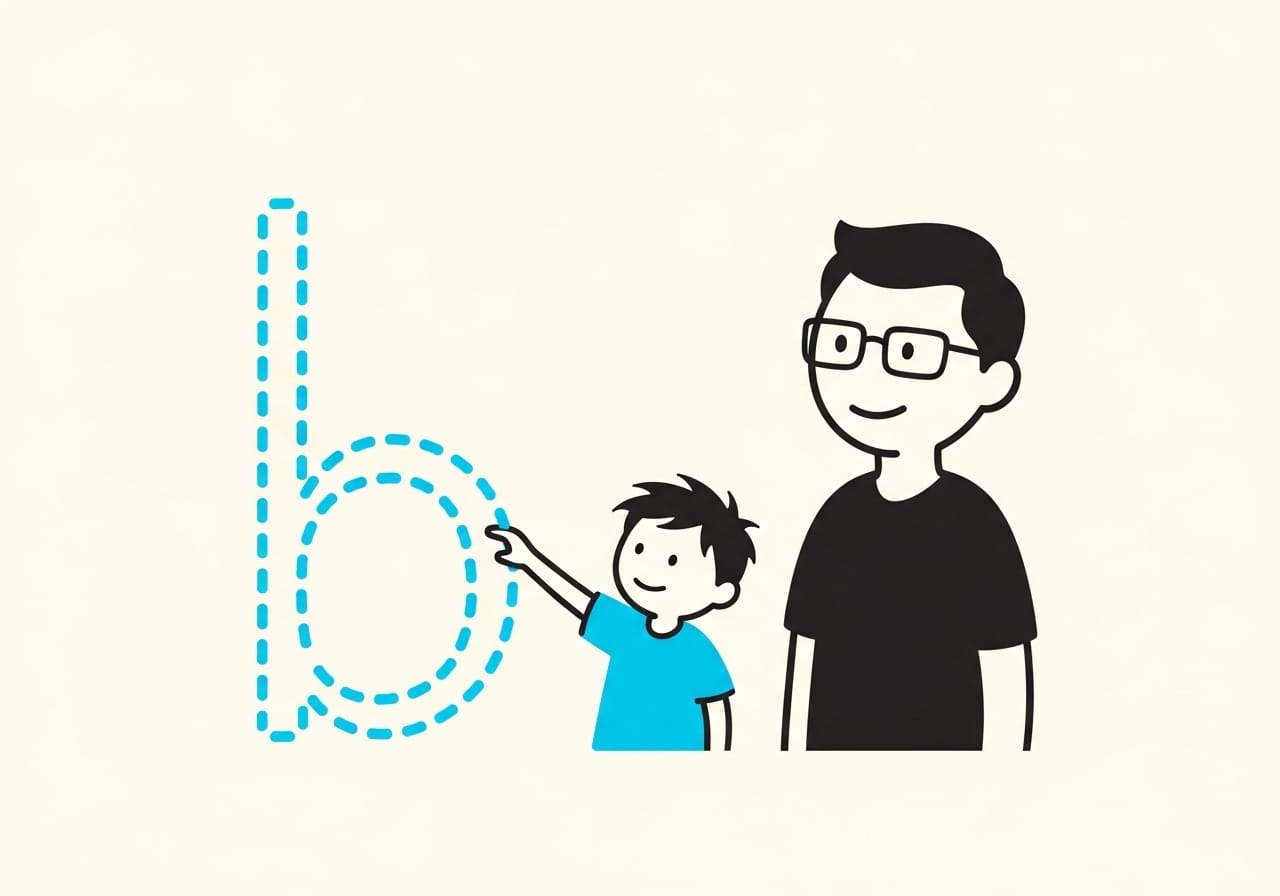
If your child needs a little help overriding their brain's natural instinct to flip letters, the most effective approach is to encourage them to stop relying solely on their eyes.
Because their visual system is temporarily applying the wrong evolutionary rule, you can help them bypass the confusion by bringing in their other senses - specifically touch and physical movement.
When a child physically feels the shape of a letter or uses their muscles to draw it, they build a physical memory of the letter's correct direction. This physical memory acts as a reliable guide to support and eventually correct what their eyes are seeing.
Conclusion
For a child, moving from being a beginner to a fluent reader takes a lot of mental effort and internal rewiring of their brain. When your child writes a "3" backward, they are not failing. It actually proves their eyes and brain are working perfectly together. Their brain is simply applying the natural evolutionary rule that an object remains the exact same thing no matter which direction it faces.
It also shows your child is actively learning and applying patterns to the alphabet.
Development rarely operates on a strict timetable. An occasional reversed letter from an older child is no cause for panic. If the reversals remain their primary way of writing well into their later primary years, or if they are paired with a noticeable struggle to learn letter sounds, checking in with a professional can offer peace of mind and targeted support.
Otherwise, the vast majority of backward letters are simply the natural signs of a brain adjusting to a newly symbolic world.
References
2025, Kanitaki, E., Unveiling mirror-writing: exploring the phenomenon in typically developing children within the Greek school context, Journal of Writing Research
2025, Tiwari, V. et al., Akshar Mitra: a multimodal integrated framework for early dyslexia detection, Frontiers in Digital Health
2016, Fischer, J.P. & Koch, A.M., Mirror writing in typically developing children: A first longitudinal study, Cognitive Development
2015, Borst, G. et al., The cost of blocking the mirror generalization process in reading: evidence for the role of inhibitory control in discriminating letters with lateral mirror-image counterparts, Psychonomic Bulletin & Review
2014, Kezilas Y. et al., The locus of impairment in English developmental letter position dyslexia, Frontiers in Human Neuroscience
2003, Lachmann, T. & Geyer, T., Letter reversals in dyslexia: Is the case really closed? A critical review and conclusions, Psychology Science
1985, Cornell, J.M., Spontaneous mirror-writing in children, Canadian Journal of Psychology

Most parents think lifting weights is dangerous for children. Twenty years of paediatric consensus disagree, and the reason has more to do with the nervous system than with muscle.

Parents are told that writing by hand is vital for their child's growing brain, and that screens are eroding it. We sort the viral headlines from the solid evidence, and find the real benefit belongs to one group above all: children still learning their letters.

Your child's fussiness for food is mostly inherited, and most of the things parents try in order to fix it make it worse. Find out why young children refuse food, why it is rarely a parent's fault, and the unglamorous method that genuinely changes how they eat.

Most of what shapes a young life turns out to be joyful and ordinary. A major new study shows what teenagers themselves treasure, and why the way they answer can tell you how they are really doing.